


No products in the cart.
-

Sandal for man gladiator model Asciano realized for Philippe
220,00 €Asciano model men’s sandal in leather and rubber sole.
Gladiator sandals with flip-flops in vegetable-tanned leather tailor-made for you by Mario Doni.
Model: Asciano
Insole: Padded with real leather Vegetable
Sole: Gloxi vibram rubber soleUpper: Natural tanned leather
Color: Antique BrownAvailable in 7 days + Delivery
-

Sandal leather for men model Agliana realized for sandro
105,00 €Sandal flip-flop for men in vegetable tanned leather Agliana model.
Handcrafted Tuscan leather sandals created and personalized for you by Mario Doni.
Model: Agliana
Insole: Natural sewed leather
Sole: Natural leather
Heel: Leather 3 mm
Upper: Natural tanned leather
Color:Antique BrownAvailable in 7 days + Delivery
-

Sandal Elba for Man realized for ross
103,00 €Model: Elba
Insole: Natural tanned leather
Sole: Natural leather
Heel: Leather 3 mm
Upper: Natural tanned leather
Color: LeatherAvailable in 7 days + Delivery
-

Sandal Etruria for Man mod. Franciscan in leather Flex realized for Stefano58
120,00 €Model: Etruria
Insole: Natural sewed leather
Sole: Natural leather Flex
Heel: 10 mm inn Leather and rubber
Upper: Natural tanned leather
Color: Mustard YellowAvailable in 7 days + Delivery
-

Sandal Etruria for Man realized for Mirko
117,00 €Model: Etruria
Insole: Genuine vegetable tenned leather
Sole: Natural leather
Heel: 10 mm inn Leather and rubber
Upper: Natural tanned leather
Color: Cobalt BlueAvailable in 7 days + Delivery
-
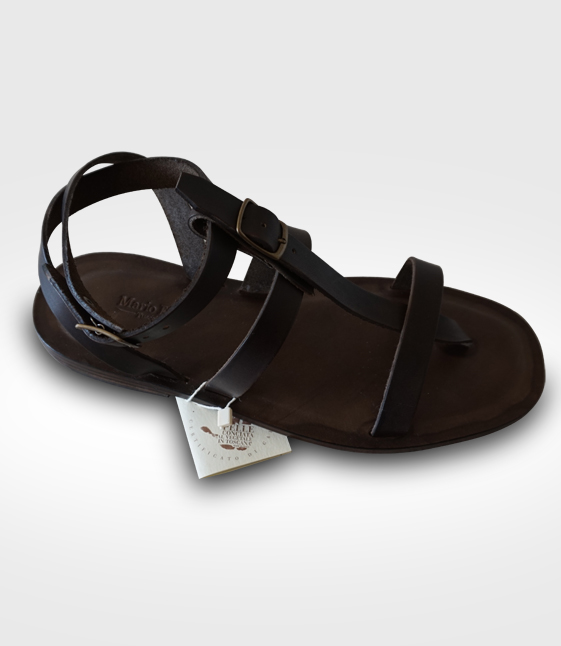
Sandal Fiesole for Man realized for Josuè
120,00 €Model: Fiesole
Insole: Padded Natural tanned leather
Sole: Natural leather
Heel: 10 mm inn Leather and rubber
Upper: Natural tanned leather
Color: CacaoAvailable in 7 days + Delivery
-

Sandal Fivizzano for Man in leather flex for Fedon
127,00 €Model: Fivizzano
Insole: Padded with real leather Vegetable
Sole: Natural leather Flex
Heel: 3mm Leather
Upper: Natural tanned leather
Color: Antique brownAvailable in 7 days + Delivery
-

Sandal Fivizzano for Man realized by Marcello
117,00 €Model: Fivizzano
Insole: Genuine vegetable tenned leather
Sole: Natural leather
Heel: Leather 3 mm
Upper: Natural tanned leather
Color: Dark blueAvailable in 7 days + Delivery
-

Sandal Gambassi for Man closed Antica Toscana in flex leather realized for Carlo
128,00 €Model: Gambassi (Antica Toscana)
Insole: natural flex leather 5 mm
Sole: Natural flex leather 5 mm
Heel: Leather 5 mm
Upper: Vegetable tanned leather “Antica Toscana”
Color: NaturalAvailable in 7 days + Delivery
https://youtu.be/LXqep_8KYSQ
-

Sandal Gambassi for Man mod. Gladiator in leather flex realized for Fis
132,00 €Model: Gambassi
Insole: Padded with real vegetable leather and stitched
Sole: Natural leather Flex
Heel: Leather and rubber 10 mm
Upper: Natural tanned leather
Color: redAvailable in 7 days + Delivery
-

Sandal Gambassi for Man mod. Gladiator realized for Mario
122,00 €Model: Gambassi
Insole: Padded with real leather Vegetable
Sole: Natural tanned leather
Heel: 10 mm inn Leather and rubber
Upper: Natural tanned leather
Color: Night BlueAvailable in 7 days + Delivery
-

Sandal Gambassi for Man realized by alberto
120,00 €Model: Gambassi
Insole: Padded with real leather Vegetable
Sole: Rubber wedge
Upper: Natural tanned leather
Color: TaupeAvailable in 7 days + Delivery
-

Sandal Giglio for Man realized by Luca
105,00 €Model: Giglio
Insole: Natural sewed leather
Sole: Natural leather
Heel: Leather 3 mm
Upper: Natural tanned leather
Color: CacaoAvailable in 7 days + Delivery
-

Sandal Giglio for Man realized by mp
105,00 €Model: Giglio
Insole: Natural sewed leather
Sole: Natural leather
Heel: Leather 3 mm
Upper: Natural tanned leather
Color: TaupeAvailable in 7 days + Delivery
-

sandal gladiator for man model Asciano realized for Patrick
200,00 €Men’s gladiator sandal in Tuscan leather Asciano model.
Handcrafted sandals with flip-flops in vegetable-tanned leather tailor-made for you by Mario Doni.
Model: Asciano
Insole: Padded with real leather Vegetable
Sole: Natural leather
Heel: 3mm Leather
Upper: Natural tanned leather
Color: Dark BrownAvailable in 7 days + Delivery
-

Sandal Gorgona for Man realized by 00449
115,00 €Model: Gorgona
Insole: Padded with real leather Vegetable
Sole: Natural leather
Heel: 10 mm inn Leather and rubber
Upper: Natural tanned leather
Color: LeatherAvailable in 7 days + Delivery
Handmade leather sandals: what that actually means
"Handmade" is printed on almost any label these days. In our case it means something specific and verifiable: when you order a pair of men's leather sandals from Mario Doni, that pair doesn't exist yet. It gets cut, stitched, trimmed and polished by hand in our workshop in Santa Maria a Monte, near Pisa, after you place the order. There is no warehouse of finished pairs waiting for a buyer, and no machine turning out three hundred an hour.
That's why every product page carries the name of the person that sandal was built for. It isn't a marketing flourish — it's the workshop's archive, made public. Every pair you see on this page has already been on someone's foot.
Vegetable-tanned leather from Italian tanneries
We use vegetable-tanned leather and real hides from Italian tanneries, and nothing else. No synthetics, no glue standing in for a stitch, no coating hiding an inferior layer underneath.
Vegetable tanning uses plant tannins instead of chromium. It takes weeks rather than hours and costs more — in return it produces leather that breathes, doesn't hold odours, and moulds to the foot that wears it. On the first outing a leather sandal is stiffer than a rubber footbed. By the second week it has taken the exact shape of your foot and never loses it. Nobody else's foot fits it after that: it's yours in the literal sense.
Made-to-measure sandals: how it works
With Build Your Ideal Sandal you choose the model, leather colour, sole type and finishes, and the sandal is made in your size.
If you have wide or particularly narrow feet, a high instep, an orthotic to fit, or any orthopaedic requirement, write to us before ordering: in most cases we adapt the model at no extra cost. This is precisely what industrial production can't do and a workshop can. Making the sandal takes 7-10 working days on average, plus shipping.
Choosing your model
The men's collection falls into four families, all in the same quality of leather:
- Barefoot sandals — thin, flexible sole, zero drop. The foot works as if bare, protected but not constrained. Four models, from the minimal Mod. 01 to the more structured Mod. 04. The choice for anyone coming from minimalist footwear.
- Gladiator sandals, Antica Toscana line — crossed straps and ankle lacing, following the design of Roman caligae. Arezzo, Arno and Asciano, in ascending height. They hold the foot steady even on broken ground.
- Leather thong sandals — Abetone and Agliana. Toe post, heel strap, nothing superfluous. Light, on your feet in three seconds.
- Closed sandals — covered toe in Cuoio Flex, cage construction. The closed Arno is the most protective piece in the catalogue: it breathes like a sandal and protects almost like a shoe.
Getting the size right
Stand your foot on a sheet of paper against a wall and measure the length in centimetres, in the evening, when the foot has swollen slightly. Compare the figure against the size guide.
Caught between two sizes, take the larger one: leather gives about half a size in the first few weeks and never shrinks. If the size is wrong, returns are available under our returns policy.
A pair that lasts six summers
The rubber sole is replaceable. When it wears through, the sandal gets resoled — by us or by any cobbler — instead of going in the bin. The leather upper, if it's looked after, outlasts the sole by a wide margin.
Care is trivial: a damp cloth after wearing, and two or three times a season a coat of leather grease or neutral wax. The one thing to avoid is drying them by a radiator or in direct sun — the leather stiffens and eventually cracks. Getting them wet is fine, as long as they dry at room temperature.
Do the arithmetic: a €130 pair that lasts six summers costs around €22 a year. A €40 pair replaced every summer costs €40. With the difference that the first one, after the first summer, is your sandal and nobody else's.
What customers say
4.2 out of 5 across more than 340 verified reviews collected by Feedaty, which certifies them as coming from real buyers. You'll find all of them at the foot of this page — including the three-star ones.
See also


